Random Variables
- \(X\colon S \to \mathbb{R}\) such that for each real number \(x\), \[\left\{s\in S \vert X(s) \le x\right\} \in \mathcal{E}\]
- Discrete variable: finitely many or countably many possible values
- Continuous variable: uncountably many possible values, with each single value having probability 0.
- Cumulative Density Function (CDF): \[F(x) = \operatorname{P}\left(\left\{s \in S \vert X(s) \le x \right\}\right) = \operatorname{P}(X \le x)\]
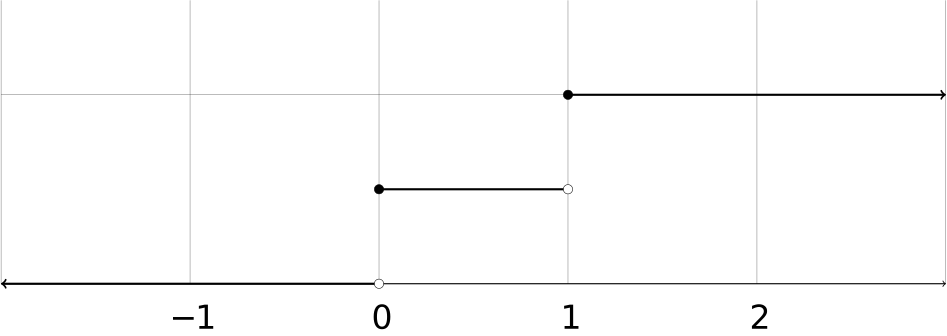
Example 1
\(X = {}\) the number of heads when flipping a single coin:
![]()
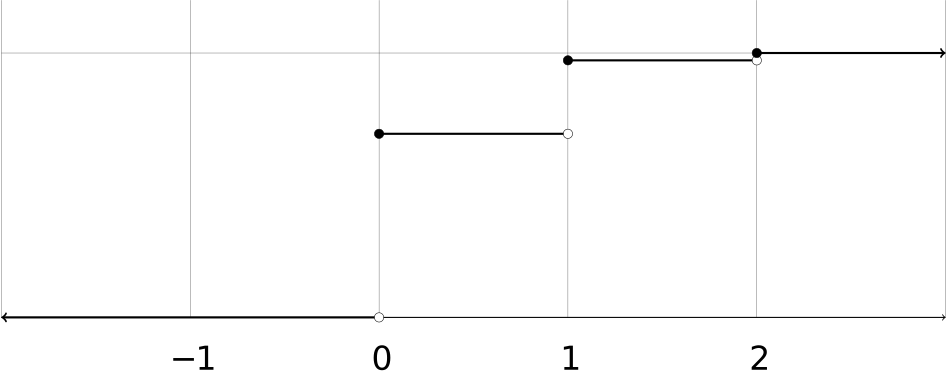
Example 2
\(X = {}\) the number of sixes when rolling two dice:
![]()
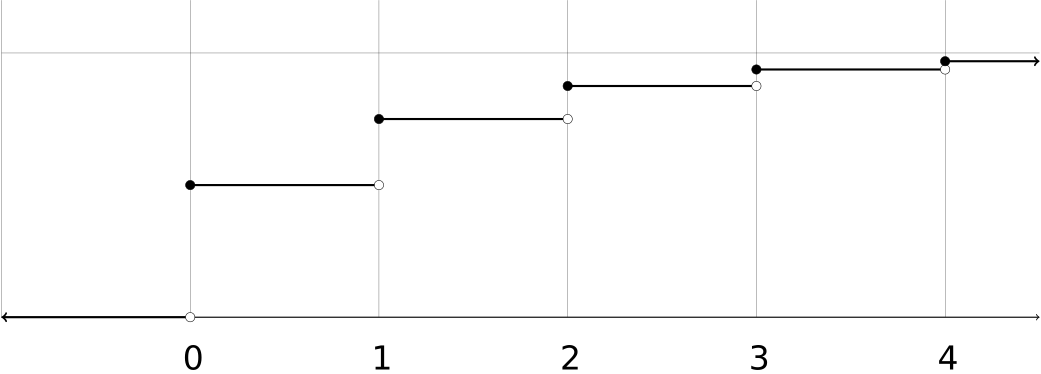
Example 3
\(X = {}\) the “waiting time” for the first head when repeatedly flipping a single coin:
![]()
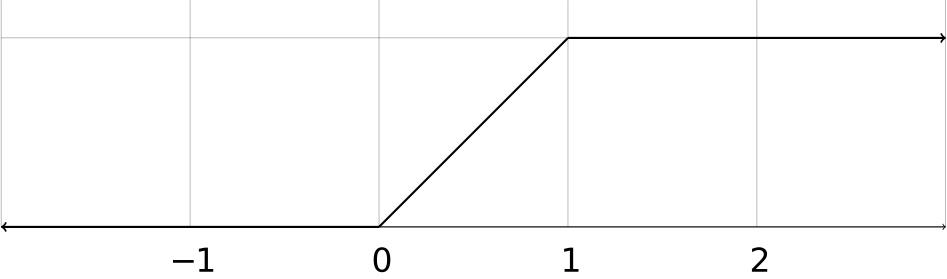
Example 4
\(Y = {}\) the \(y\)-coordinate of a point where a photon strikes a square sensor.
![]()
Discrete Variables
Finitely many or countably many possible values
CDF is “piecewise constant” (step functions or “jump” function)
The “jumps” occur exactly at the possible values.
The height of each “jump” is exactly the probability of that value.
Probability Mass Function (PMF), sometimes called Probability distribution function (PDF) gives probability for each possible value.
\(p(a) = \operatorname{P}(X = a)\)
- \(p(a) = 0\) if \(a\) is not a possible value of \(X\).
- Sum over all possible values must be 1.
- \(\displaystyle F(x) = \sum_{x_i \le x} p(x_i)\).
Special Families of Distributions
- Discrete Uniform
- Categorical
- Bernoulli
- Geometric
- Binomial
- Poisson